
- Investments152,000 €Machinery, vehicles, fittings, IT: everything you use for more than a year.
- Start-up costs6,000 €Notary, commercial register, advice, website and rent deposit.
- Ramp-up costs69,553 €Shortfalls of the first months until income covers spending.
- Working capital91,049 €Money tied up in stock and unpaid customer invoices.
- Liquidity reserve25,000 €A buffer for anything that turns out differently than planned.
Example: starting an electrical contracting business
A fictional business for electrical installation and solar systems. This is how the capital requirement appears in the Excel workbook.
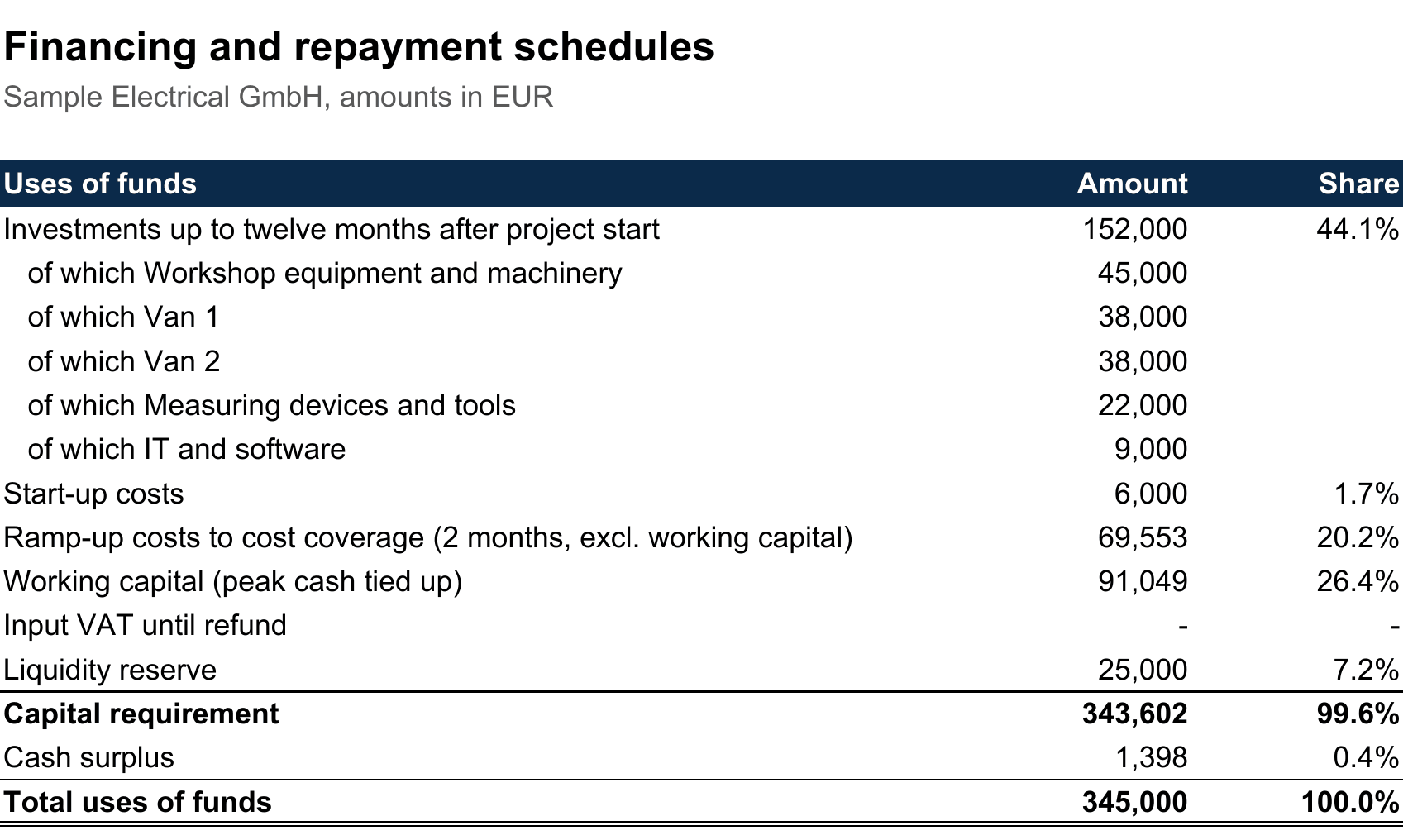
From capital requirement to financing
Use of funds and source of funds must be equal. If a gap remains, the bank asks where the missing money is supposed to come from. What you buy for the long term, you finance for the long term.
Use of funds
- Capital requirement343,602 €
- Cash surplus1,398 €
Source of funds
- Equity 26.1%90,000 €
- Bank loan 73.9%255,000 €
Typical mistakes
- Forgetting working capitalMaterials and wages are paid, customer invoices are still open. In the example, this is the second-largest item at 91,049 €.
- Not pre-financing the VATOn 152,000 € of investments you pay 28,880 € input VAT before the tax office refunds it. In the example, it is included in the ramp-up costs.
- Forgetting living costsUntil the business can support you, you need money to live on. Plan your salary or owner's drawings from the first month.
- Full revenue from month oneWinning customers takes time. If revenue starts at full level, the ramp-up costs come out too low.
- No reserveAdditional financing later is harder to obtain than a buffer in the first application.
- Short-term money for long-term purchasesWhat you use for years, you finance over a similar term. A machine on the overdraft is expensive and blocks the facility.
Frequently asked questions
What is the difference between a capital requirements plan and a financing plan?
The capital requirements plan shows how much money you need and what for. The financing plan shows where the money comes from: equity, loans and grants. Together they set the use of funds against the source of funds.
Does VAT belong in the capital requirement?
You plan investments and costs net. But you pay the VAT on them first and only get it back from the tax office after the VAT return. This interim financing belongs in the capital requirement. Small businesses without input tax deduction calculate all spending gross.
How large should the liquidity reserve be?
There is no fixed rule. What matters is how certain your revenue is. Check in the cash flow forecast whether the lowest account balance stays above zero even with weaker revenue. In the example, the reserve is 25,000 € with a lowest account balance of 59,232 €.
What period do I plan the capital requirement for?
At least until the month in which income covers ongoing spending. Planvik looks at twelve months from the start of the project: all investments in this period, the ramp-up costs up to cost coverage and the highest level of working capital.
What do I do if the financing does not cover the capital requirement?
Then a financing gap remains, and the bank asks where the missing money is supposed to come from. Possible ways are more equity, a larger loan, public funding, staggered or leased purchases and a leaner launch phase. Planvik shows an open gap separately in the plan.
Does Planvik calculate the capital requirement automatically?
Yes. From your inputs on investments, revenue, costs and payment terms, Planvik determines the capital requirement and sets it against the financing. In the Excel file, the items are on the Summary and Financing sheets, the month-by-month calculation on the Workings sheet.